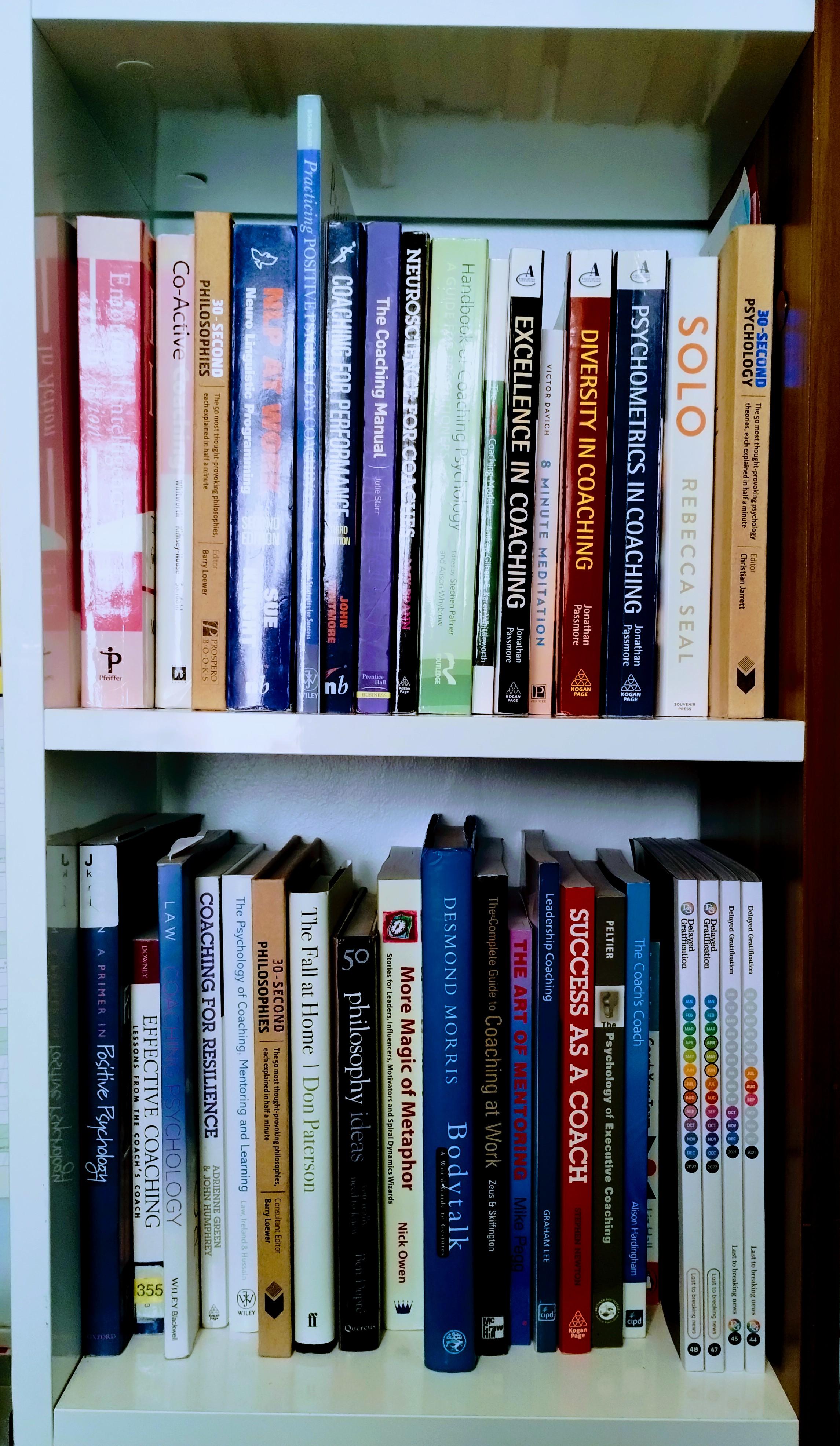

As an avid reader, I never need much of an excuse to go on a book buying spree. I got an email a few months ago from the Learning & Development department at work to say that they were in the process of cleaning out the library and restocking it, and did I have any recommendations or requests for the coaching section?
In my office room at home, just out of sight, behind my desk chair, I have a comfy reading seat, with a standing anglepoise lamp (my eyesight isn’t quite what it was) and a well stocked bookshelf with all my favourites and a burgeoning “to read” pile. If I’m ever in need of a change of scene from my surround-sound screens, it’s nice to be able to tuck into a chapter or two of something to broaden my horizons.
I think every coach should build a little library for themselves to help them periodically refresh their skills and stretch and deepen their experience.
Good Starting points
During your initial coaching training you will have been introduced to a coaching model, and some underpinning tools and techniques. I was trained by Karen Whittleworth and still have my well thumbed copy of The OSCAR model with its spine broken on all the touchstone models, Covey’s circles of concern/influence/control, the personal iceberg and the belief cycle. The scientist in me has never been great at learning things by rote (which is why I specialised in organic chemistry rather than inorganic) so I’ll often dig back into those early textbooks for a refresher whenever I think I’ll need to explain them to someone or use them in my practice. The other main coaching model that people are often taught is the GROW model, by Sir John Whitmore. His book – Coaching for performance, is another treasure trove of starting blocks and foundations, all scrupulously annotated with references to other articles, papers and books. Using these starting points as a bit of a Rosetta Stone, or map, to discover other places to explore would be my first top tip. If there’s a model, a quote, or a concept that really resonates with you and your coaching practice, have a delve into where that originated and also have a look to see what other things have been written on the topic.
Further Inspiration
Workplace coaching is, at heart, a practical application of a number of overlapping fields (if we were drawing out a Venn diagram). So you might want to have a deeper look into these underpinnings and read up about cognitive behavioural theory (CBT), Neuro-linguistic programming (NLP) or Positive Psychology (PP? I don’t think I’ve ever seen it abbreviated). Some of the branches off from those fields have become their own areas of study that people have devoted entire PhDs/lifetimes of work to explore. Transactional analysis (TA) and neuroscience both have huge numbers of books written on their theory and practical application including a number of books that focus on their application to the work of coaches, that I’ve found particularly interesting. Coaching can also take into account cultural differences and can look at a very narrow area of focus or try to encompass the whole (an holistic approach that Douglas Adams might have been tempted to pursue). Seek out recommendations and reviews for books that cover the topics that you’re interested in (at the outset you could think about Amazon or Goodreads) and often there are articles and excerpts online so that you can get a sense of an author’s style of writing and see whether you find it approachable and readable before you plonk your money down for their full work.
Discovering new routes
When my son was little and I was trying to instill a similar love of reading in him, I found that it’s really key to have a variety of options available, so that if you’re in the mood to read, you have a selection or choice from which to pick. Having a note taking app on your phone (or, retro style, a little notebook) in which you can jot down interesting topics or authors or concepts to explore, or recommendations when people drop them in coincidentally, is a fab way to build up a burgeoning to-read pile. The more you read and the more you explore, the more avenues of further research and work are uncovered (and also the more certainty you gain around the themes that don’t click with you). It’s basically a bit like the loops that you can get into on YouTube or Spotify (note here the rich ground of TED Talks, and podcasts, and Audiobooks too) in which watching one video on a theme will prompt recommendations of others.
I guess much of this article has been a bit of a tease. But what’s in your capsule library Mark? I hear the handful of people who’ve made it this far ask…
Well, here you go:
The OSCAR coaching model – Andrew Gilbert & Karen Whittleworth
Coaching for Performance – Sir John Whitmore
The coaching manual – Julie Starr
The coaches’ handbook – Jonathan Passmore
Co-active coaching – Laura Whitworth, Henry Kimsey-House & Phil Sandahl
Neuroscience for coaches – Amy Brann
Handbook of coaching Psychology – Stephen Palmer & Alison Whybrow
NLP at work – Sue Knight
Practicing Positive Psychology Coaching – Robert Biswas-Diener
Emotional intelligence in action – Marcia Hughes, L.Bonita Patterson & James Terrell
Grabbing a handful of these and really immersing yourself in their teaching would give plenty of brain food for a good few years at least, but don’t let me hold you back from ordering more and wilder picks. It’s the start of the journey and the journeying is the most interesting part.
(Let me know your favourites and recommendations too!)
(I’m planning on doing some reviews in future blogs, so keep an eye out for those).