Ten years ago I was pulling together research and information for a leadership development session at work. There had been a lot of coverage in the news about the beneficial impact of having an optimistic mindset and so my plan was to do a light trawl of the literature, pick out some nuggets to share, and bookend it with an intro on what coaching is and what it could do, then finishing up with a plug for our coaching network.
In the event I ended up getting bogged down in conflicting studies. There was a chunk of mainly management literature and research which promoted optimism as an unalloyed benefit. Conversely, there was a bunch of (mainly health) studies which warned of some of the risks associated with taking an optimistic view. Neither set of studies seemed to acknowledge the other’s existence in the slightest.
It always helps to start off any survey of this kind with a check of definitions, to try to ensure that everyone is talking about the same thing.
Definition – Optimism is about having a positive attitude towards the future.
A pessimist is never disappointed (Sophie Ellis-Bextor’s early indie years)
theaudience – A Pessimist Is Never Disappointed (Official Music Video)
Folk wisdom has it that you shouldn’t ever build up people’s hopes too much, to save them from the disappointment if things don’t come to pass. The studies looking at how people fared when going into situations with low/medium/high (or no) expectations tended to focus on the experience of gamblers. It was shown that an unexpected win from low expectations had a more beneficial effect than win from an expectation of a win. Unsurprising, but this is in the context of something we don’t have control over, which seemed to get to the heart of the differences between the studies.
Setting expectations which rely solely on others and over which we have no influence is a fools game. Being optimistic around things you have no control over has no benefits, indeed it’ll often have negative consequences (the studies looked at the dangers of being optimistic over gambling and sexual health).
This seems to loop back to Stephen Covey’s famous circles of influence – look to expand and concentrate your effort on what you do have control of in life as that will have a knock on effect on everything else (whereas focus on things you are concerned about, but have no influence or control over is an unhelpful distraction).
I was also surprised to discover that the majority of people have a bias towards optimism in relation to their personal circumstances (albeit a pessimism in relation to the state of the world). It’s well worth having a look at Tali Sharot’s TED talks on the topic. On average, we expect things to turn out better than they wind up being. In a nutshell people hugely underestimate their chances of getting divorced, losing their job or being diagnosed with cancer; expect their children to be extraordinarily talented; envision themselves achieving more than their peers; and overestimate their likely life span(sometimes by 20 years or more).The belief that the future will be much better than the past and present is known as the optimism bias. It abides in every race, region and socioeconomic bracket. A 2005 study found that adults over 60 are just as likely to see the glass half full as young adults. You might expect optimism to erode under the tide of news about violent conflicts, high unemployment, tornadoes and floods and all the threats and failures that shape human life. Collectively we can grow pessimistic – about the direction of our country or the ability of our leaders to improve education and reduce crime. Our brains will accept information more readily if it is framed towards a positive action (positive actions will tend towards achieving things – negative stuff can often be avoided by inaction).
But pessimism isn’t the answer either. Lowenstein researched this in the mid-80s and found that anticipation is powerful. Expectations matter because people with high expectations credit themselves when things go well and blame circumstances when things don’t go well – if the exam went badly it was because it was particularly tough, not because it was their fault. People who have low expectations think if things went well it’s the exception and expect that the next time the world will revert to type and go badly again. They blame themselves when things don’t go well. Essentially optimists still feel as though the next time they do something it is still within their control, which has been shown to improve their chances of success in the medium term.
The evidence shows that optimism changes objective reality. It makes people try harder/be healthier/more successful. Cognitive neuroscientist Sara Bengtsson manipulated the positive & negative expectations of students during cognitive tasks – those primed to be optimistic did better. Examining the brain scan data their brains reacted differently when encountering mistakes in the test – those primed to be optimistic fired in the anterior medial part of the prefrontal cortex – which essentially flagged a heightened awareness when mistakes happened. The negative primed students had no reaction and so continued to make mistakes.
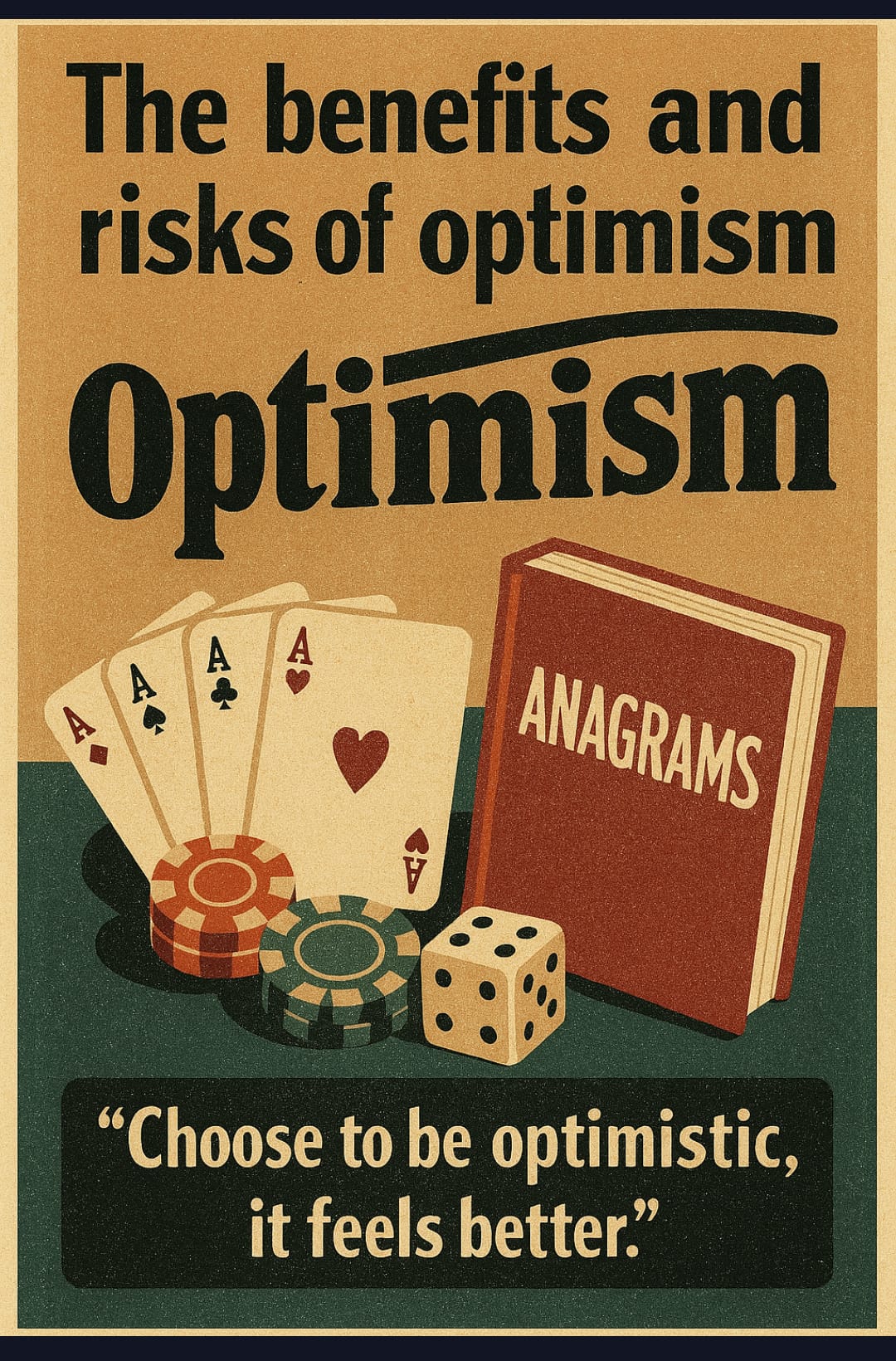
If you ever needed evidence that psychologists are mean you don’t have to look much further than the Anagram Test (I’ve tried this in workshops). People are given a list of anagrams, some of which have no solutions, and an open ended time in which to do as much as possible. The people who tried longest were generally more successful in other spheres of life, as persistence in tasks does matter. (Tho in the session I ran, one particular eager attendee did manage to find an obscure, but true, solution to an anagram that I’d thought was insoluble… fortunately I’d added an extra couple of genuinely decoy ones, but Kudos to you Beth!).
Chunks of Freud’s work have been debunked by modern neuroscience – such as his suggestion that expressing anger and anxiety, “blowing off steam” was needed to progress. This is wrong. Recent studies show that people who vent don’t move on and continue to have lower resilience. By contrast those who get distracted by positive things improve, as do people who look to learn from what went wrong and look to build from that to something better. This all makes sense when you view it in the terms of neural pathways that are strengthened by repetition.
This also has links to resilience too, Barbara Fredrickson (Professor, North Carolina)showed the advantages of having a resilient approach in which it was revealed that resilient people responded well because they are good at turning a negative state of mind into a positive one,viewing it as an opportunity to learn and grow. They also weren’t delusional about it, they experienced exactly the same negative reactions, but quickly recognized this and moved onto practical solutions to get past it. The crucial, crucial point was that non-resilient people who were primed to complete the stressful task in a positive way had all the same benefits as the resilient people. It can be learned.
So where does coaching end up in all of this? For me, it’s all a question of ensuring that people can have (and feel) some agency in their lives. When people have a plan of what they can do to take control of a situation it helps them to feel that positive attitude towards the future. Coaching is an essential tool in enacting this.
I’ll leave you with a couple of contrasting quotes.
“If you expect nothing from anybody, you’re never disappointed.” ~ Sylvia Plath
“Choose to be optimistic, it feels better” Dali Lama XIV
