
Towards the end of the last decade conversations at work, and over coffee with friends turned, surprisingly regularly, to the topic of mindfulness. It seemed to have been added to the list of everyone’s day to day chores, with my acquaintances all going through something of a curve in which they started out sceptical, then grew curious, then evangelical, then disillusioned before winding up at sanguine.
My early exposure to it as a practical tool that might be useful came from having Professor Paul Gilbert’s wonderful book “The compassionate mind” recommended to me when I was going through a tough patch in life. The first section of the book gives a tour through the evolution of the brain and how and why our minds have evolved in the ways that made sense from a biological standpoint, but which have quirks which render them pretty problematic in the modern world. The selection of exercises in the second half of the book was interesting, but I found that in many ways I’d gleaned a lot of what I needed at the time from being able to understand what my brain was doing.
The next step in my mindfulness exploration was through Victor Davich’s wonderfully accessible 8-minute meditation book. There are a lot of meditation books with a religious slant, which makes sense considering the history and traditions in which it developed, and then evolved into mindfulness. Davich’s approach allows you to try out a whole series of types of meditation, in a simple and non-judgy, bullet-pointed practical style. I recommend it a lot.
I went through that course and found a combo of approaches that meant I could keep things interesting when I got bored of one that was anchored in the breath, but also that I had an everyday meditation practice that I could access, and click into without too much preparation or thought.
As is the modern way, I also kicked into gamification of my meditation. For anyone who has worked up a stretch on Duolingo, you’ll know how compelling it is to make sure that you keep the run going, and how the competitive streak kicks in when you start to get ahead of your friends. Actually, this is probably a telling insight for me about my own compulsions and personality… As a family it seems that the Sextons, while being fairly laid back, can get uber competitive when it comes to board games, computer games, badminton and… Duolingo. (I’ve abandoned my epic Duolingo streak now, but ploughed on for an extra couple of months to make the streak a nice round, hard-to-assail number, even though I’d gleaned about all I was likely to from the course I was doing).
Anyway, if you want to (probably go against the whole ethos of meditation and) gamify your meditation routine, I can highly recommend insight timer ( https://insighttimer.com/ ) with it’s ultra clean timer bell options and some nifty guided meditations for if you feel so inclined. It also keeps track of how many days running you’ve meditated and so that can help keep you onboard until the two or three month mark which is usually needed for something to cease being a chore and start to turn into habit.
All things considered however, meditation and mindfulness aren’t for everyone – in their sitting still and focusing on the breath form. If you’re struggling to breathe because of health reasons or, for a variety of other mental health reasons, it might just not be the right path for you, so don’t feel obliged. That said, there is compelling evidence to suggest that there’s real benefits from training the neural pathways of the brain to bring your thought back to the present. And there are other ways in which you can do this. When I chat to colleagues who have become addicted to running (couch to 5k seems to lead to half marathons, halves to full marathons, and a select few then move on to ultras or fell running), it always seems to me to be another route into that same space. Carving out a regular part of the day in which you can decompress, but not by leaving your mind a blank tabula rasa (as the misreadings of meditation practice often suggest), but by bringing your focus truly and fully into the present and focused on a single thing. My son seems to get the same from his art and sewing.
I’m no runner, but as a child I used to swim, and, in the pool as I did laps and laps and laps (in training) after a few I’d enter a kind of automatic pilot, in which I was no longer thinking about my day, about what was coming up or what had gone on, I was just thinking about my stroke, about my turns. Then after a while even that would become automatic too, and I would just be focussing on my breath. Ah. Maybe swimming was just exercisey meditation all along?
I went back to swimming some years ago, after a long period of not, and was pleased to be able to bash out a mile pretty cleanly. It seems that swimming technique has that in common with riding a bike. My subsequently agonisingly achy muscles also went to show that badminton muscles and swimming muscles are not the same. Still, you live and learn.
Another way in which to keep you in the loop is to meditate or practice with others. At work, Conal started up a lunchtime meditation catchup, in which he would take people through a first ‘warmup’ meditation and then a longer one, all linked to guided soundtracks (possibly gleaned from Bangor University who are really exceptional in their work in this field)
https://www.bangor.ac.uk/centre-for-mindfulness
We’re social creatures and it was always nice to sit among other interested folk and hear how they managed (or struggled in similar ways to manage) to work mindfulness into their days, and the benefits they felt when they did.
Anyway, a bit like my Duolingo run, my mindfulness practice has morphed from a dedicated time everyday to now slipping into that state during washing up, or walks. I should get back to it more formally, as I feel the benefit when I do.
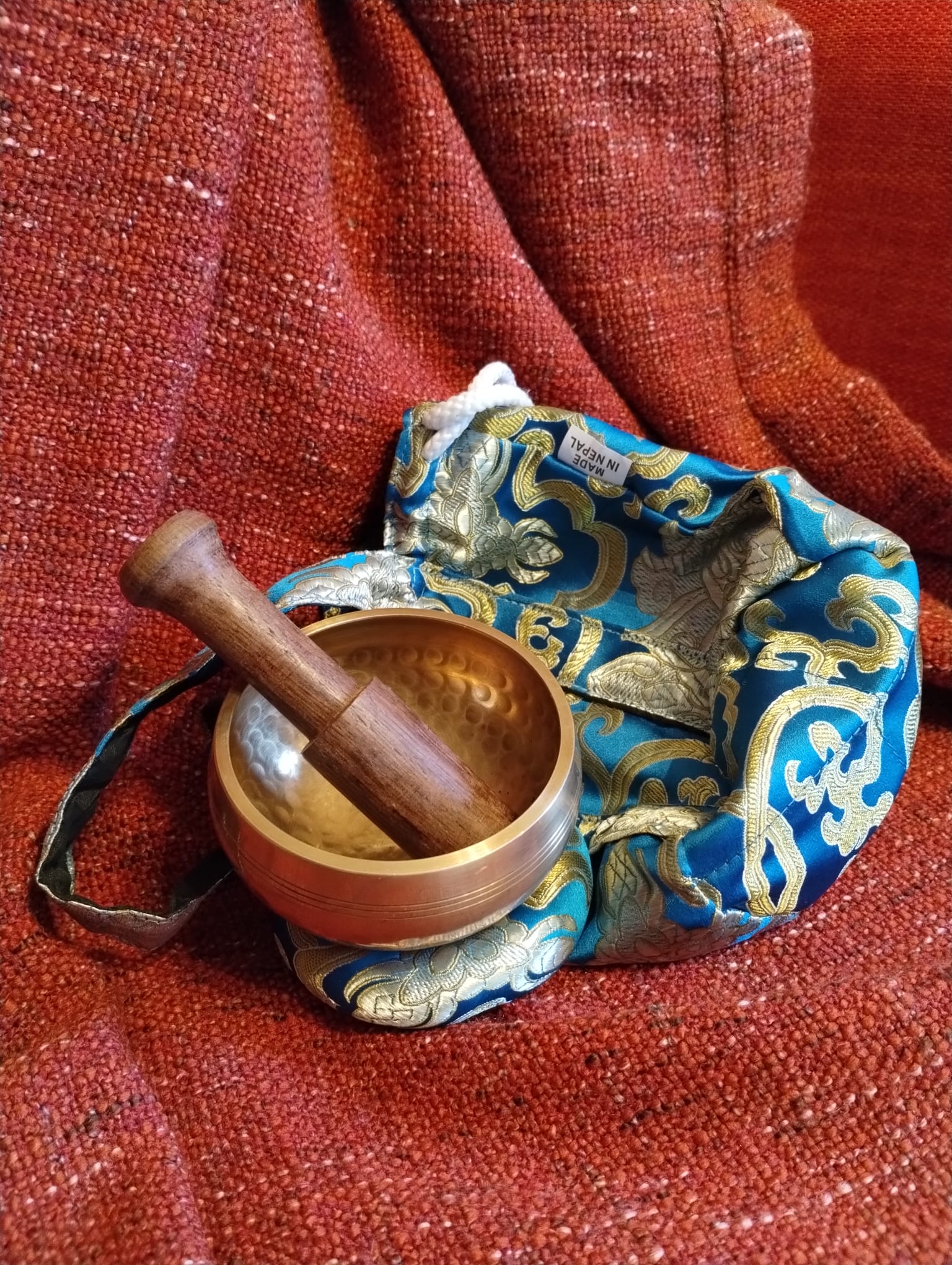
I have picked up a singing meditation bowl (a kind Christmas gift from my family) which I use to get people’s attention in training that I’m running. I figure that it brings everyone back to the present, so I don’t feel bad about using it in that way.