It’s not uncommon for me to be asked for recommendations about particular strands of coaching tools, techniques or underpinnings. I’ve got a handful of go-to texts which form the most well-thumbed end of my coaching library, and I’m constantly picking up copies of interesting looking works, raking through them for nuggets that I can share in our drop in CPD sessions or folding down the corners when I come across models, techniques or ideas that I think could be handy in my own practice.
A little over a year ago I picked up a copy of Coaching in times of crisis and transformation (also by Liz Hall) which I bought partly for the title (as there’s a load of IT projects going on across government under the “transformation” badge, which I found funny) and partly because at a coaching conference a few years ago I went to a session which looked at organisational dynamics in VUCA (Volatile, Uncertain, Complex and Ambiguous) times.
I recall around a decade ago there were quite a few training courses, books and thought pieces being published on the concept of VUCA and the ways in which various techniques could be used to build resilience or help managers and staff negotiate through these tricky times. The practical experience of the pandemic seemed to take the wind out of the sails of some of these theories, but there’s a wealth of applicable learning in this space that I think is as pertinent as ever.
I found that book quite interesting in its varied approaches, and Liz Hall’s editorship pulled together quite a wide range of different angles in which to approach the topic. Her chapters focused quite closely on wellbeing and mindfulness angles, which is a popular approach with coaches I work alongside and supervise and which I find useful as groundwork, if not actually building it in mechanically to my coaching practice.
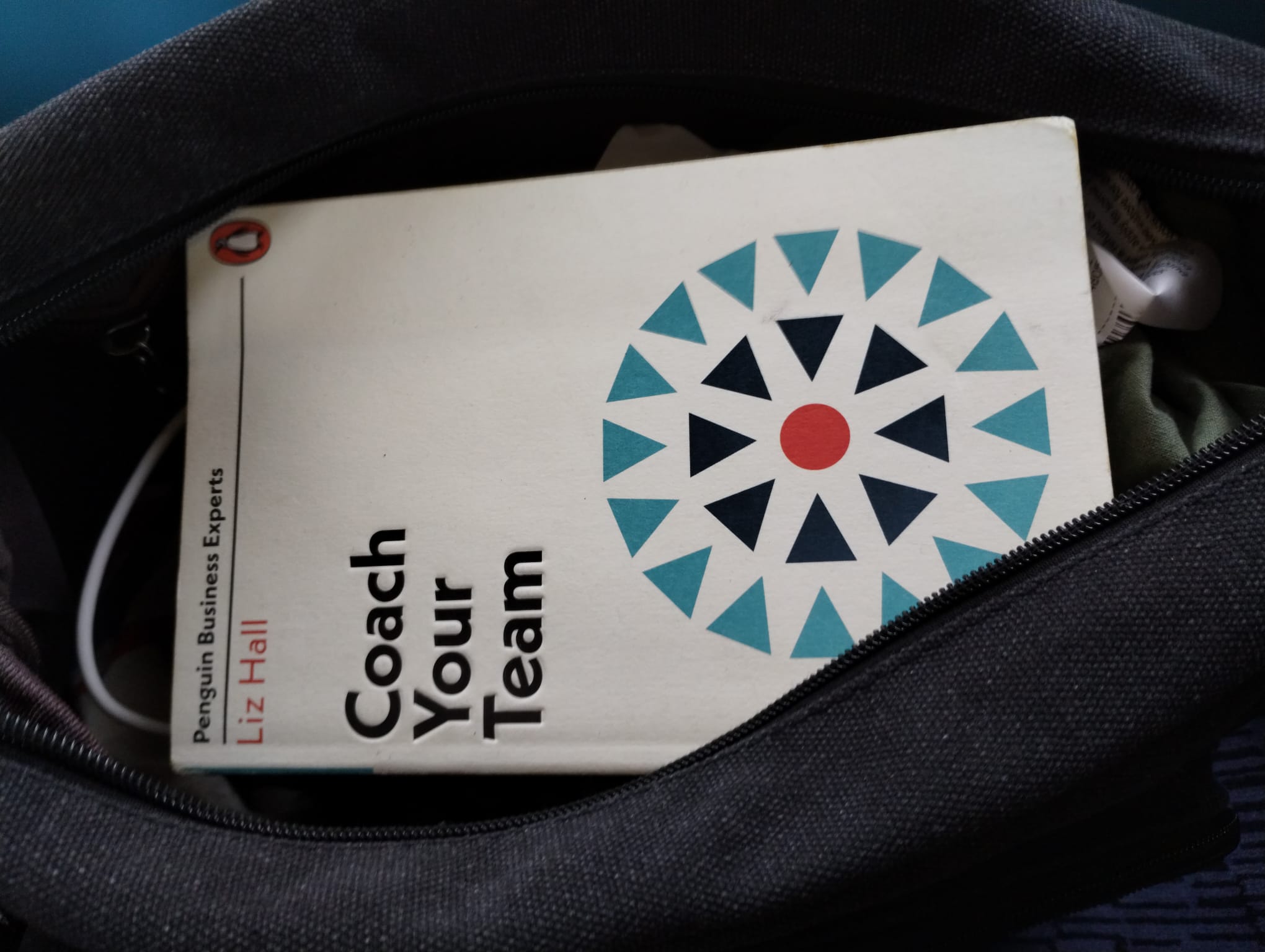
After enjoying the crisis and transformation tome, I noticed that Liz had also written another book on coaching “Coach your team”, this time in the Penguin Business Experts series and so picked up a copy of that when one of the big online retailers had a sale on.

As a bibliophile, the first thing I’d like to commend on this is that the book is beautifully sized, designed and edited. I became an avid reader on the back of buying lots of secondhand orange-spined penguin paperbacks, that really hit the sweet spot of being between 140-240 pages long (and so generally neatly edited to ensure they’re not padded out needlessly). I also love the size of them too, I’m not sure when we decided that books needed to be slightly too large to fit in a pocket, but I do think it was an error. Lastly, the cover design and material is lovely and minimalist – simple and abstract , and matt in texture (no real practical advantage, but it feels nice in the hand).
The crucial thing in any book, though, is the content, and I think that having Liz write the whole thing, it’s a more cohesive piece than the Transformation, work.
There’s a practical flow to how the chapters and topics are arranged, beginning with an elevator pitch on what coaching is and how it differs from other interventions, a brief but nicely framed introduction into mindfulness which is then looped back to throughout the practical sections of the book as a preparation technique to ensure that the client (and coach) get the most out of the sessions. This is all underpinned by the underlying research which explains the basis on which these techniques work and a wrapup of how this can be used by yourself and others.
The main section of the book is dedicated to conscious coaching, which leads the reader pithily through the foundations of coaching tools and techniques, starting with a model to self coach and then covering ways of co-creating the coaching environment, building rapport, listening levels, the use of silence and deeper questioning. It’s a real whistle stop tour of the foundation stones of a wide and solidly grounded coaching approach, and keeps to the core tenets (thereby providing a useful starting point for people to work out what things they might not know that they don’t know).
Techniques for deeper listening seem to crop up in lots of generic training courses, and there are some in the field who have written extensively and exhaustively on the topic. But I have found it hard to lay my hands on a neatly curated summary that can be picked up and read by a curious manager in a tea break and be deployable almost instantly. I think that this is where ‘Coach your team’ truly excels, by providing a primer which is packed with all the info you need to get underway, but in a digestible manner which doesn’t pad out the learning with extraneous waffle.
The following section rattles through a wide variety of tools and models (and even introduces one or two of Liz’s own) – A minor misstep in this otherwise superb review of approaches is in how the author describes her FELT model – the underlying steps are laid out pithily (and some might even say intriguingly), but somehow in the editing it’s not made clear what the F in that acronym stands for.
This guts of the book quite seamlessly melds various mindfulness approaches with some harder edge coaching tools and programs. I think that this works well, but have come across clients for whom the religious/spiritual angles are an absolute dealbreaker. Personally, I found the summary and signposting of many wonderful buddhist mindfulness practitioners really helpful. That said, if you’re wanting a more clinical and secular approach to the field, then I’d also recommend the book 8-minute-meditation by Viktor Davich as a pithy and practical survey of a variety of mindfulness practices that can compliment a coaching relationship wonderfully.
The outlines of all these coaching approaches are fleshed out a little and mapped onto the basics of Team coaching. Before the book wraps up with a series of ideas that can be used to start to build a coaching culture in your organisation.
I don’t think I can praise this book highly enough, and I think that it offers an unparalleled primer in the practicalities of coaching and the practicalities of mindfulness, which leave anyone looking to explore these further can use as a jumping off point. It is a particularly winning approach if you are wanting to underpin your coaching practice with some solid, evidence-based mindfulness approaches.
I’m also keeping my eye open for affordable copies or further sales to pick up some spares to dole out to interested colleagues.
Highly recommended.