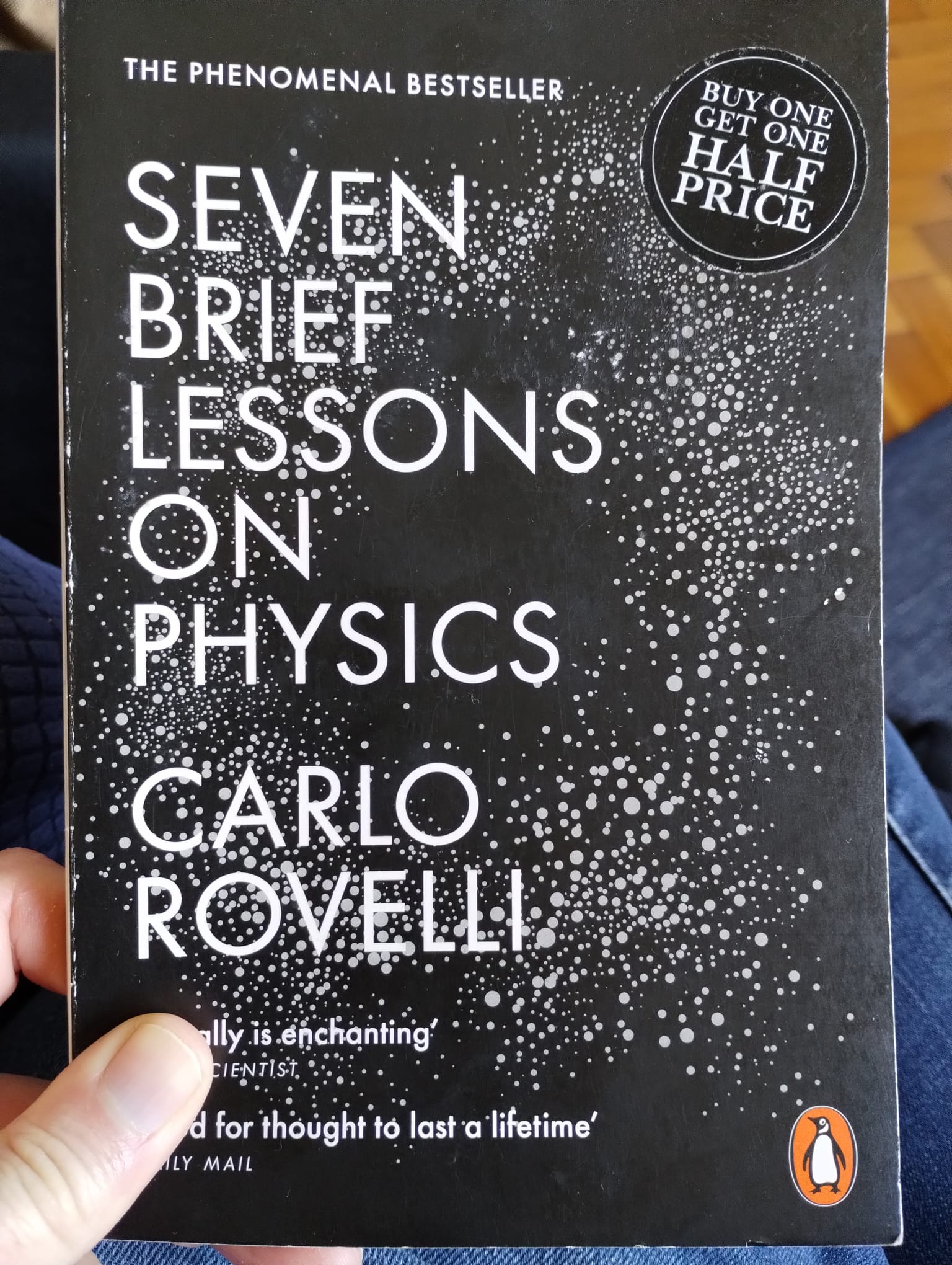
I do have reviews for a couple of coaching tomes in the works, but I keep getting distracted by other books in my reading pile. In the spirit of the blog, I find that I often draw on other sources during my coaching sessions, or the things I read spark ideas that cut across my coaching practice. In the most recent instance, I picked up a secondhand copy of Carlo Rovelli’s Seven Brief Lessons on Physics, a slender work that draws together seven (or maybe six, with a separate summing up chapter) articles that he wrote for the Sunday supplement of an Italian newspaper Il Sole 24 Ore.
I’d seen Rovelli talk with Jim Al-Khalili at the How the light gets in festival several years ago and was impressed by the enthusiastic and, above all, accessible way in which he was able to explain the complex underpinnings of modern Physics (and then use that as a platform for discussing other stuff). It’s a real boon how, over the past decade, the pioneering work of people like Stephen Hawking and Paul Davies has been built upon so that we’re now blessed with a great selection of Pop.Science works that help to bring the latest ideas and work from academia and express it in (reasonably) understandable terms to the masses.
I’d place Rovelli at the top table of scientists writing for a mass market (and special kudos should also go to his translators Simon Carnell and Eric Segre too), and this slight collection offers the perfect intro and perfect taster for anyone wanting to get their heads around the theories that currently form the basis of our understanding of reality.

So, the bite sized essays here start with Einstein’s beautiful theory (tho not his imposter syndrome, which I touched upon in an earlier blog https://coincidentalcoaching.com/2025/07/21/albert-einstein-involuntary-swindler/ ), then moves on to the mind bending ideas that underpin Quantum Mechanics, a history of how our understanding of the architecture of the cosmos has evolved (this comes with neat little illustrations), then onto particles and how our naming of such has veered from quoting from Joyce’s Finnigan’s Wake, to the unimaginative straight descriptors which led physicists to name one of the subatomic particles “Gluons” (‘cos they bind together quarks), things take a turn for the weird in the chapter on particles of space, before becoming truly mind-bending as it is all pulled together to discuss the importance of probability and the nature of heat.
There was stuff covered that I was familiar with, and ideas that I’d heard before but had always struggled to be able to understand (and yet further struggled to rearticulate, which tends to mean that I’ve not really got a decent hold on the concepts).
A few bits leapt out at me (look away now, people who dislike those of us who fold the corners down of pages). In the section on quantum mechanics Rovelli asks a series of questions, beginning with “What does this mean?”. I’ve asked that myself in coaching sessions (although being a book, in this case it’s rhetorical). The series of questions and statements that follow explore the idea that we’re only uncovering pieces of the puzzle, and with each new solution we’re able to do things we’ve not previously been able even to imagine. But in turn, that opens up new questions, and new mysteries… (ahh Douglas Adams – here’s the answer, now we need to find the question).
The penultimate section on Probability also touches on some pithy, profound, points. He explores the ways in which our intuition can lead us astray. They can be imprecise and if we’d kept to them we’d still believe the Earth was flat and orbited by the sun. They develop on the basis of our limited experience.
As I’ve written about previously on Johari’s Window ( https://coincidentalcoaching.com/2025/02/10/joe-and-harrys-double-glazing/ ), it is our role as coaches to do this, not with the fundamentals of Physics, but with our coachees. We can provide the space for people to explore and test and question their intuitions, and through that gain a greater knowledge of themselves and a broader understanding of their context and the world. The real journey of discovery is not so much seeking new lands, but seeing with new eyes.
The summing up chapter does a great job of drawing these varied histories together and presenting how they can find mirrors in our daily lives and the way that we think. How stories set the scene, but how we also pursue different paths and need to remain open to changing our pursuits when the evidence changes. The borders between science and myth can be porous, but the value of knowledge remains.
For such a slender book the theories and ideas cleverly and succinctly covered have stayed with me. As you’ve probably gathered from reading my previous posts I do enjoy finding stuff that can add mulch to the development of my coaching practice wherever and whichever ways I can.
I was travelling back from a day long mediation yesterday, and, taking a stroll around WH Smiths (at the station – they still exist there and have avoided the horrific highstreet rebrand) I noticed the huge wall of self-help and business books, among all the magazines and sweets. It got me thinking about the nature of travel and wondering why it’s when we’re flying, or en-route somewhere that we seek to dial into these preachers at the agora, claiming to be able to help us get fit, well or organised.
What heartened me more was looking one shelf over, at the fiction. There was an absolutely remarkable array of great novels there, in only a handful of rows they had Primo Levi, next to Len Deighton (underrated), Jane Austin next to some great modern stuff. We should glean inspiration and reflect on life from as many sources as we can find (and are enthusiastic to learn from). Plato would approve.