
Happy advent everyone. This week I’ve been pondering what food I’ll be sorting for Christmas and nipping out to some of Cardiff’s diverse food shops to pick up bits and bobs for the home-made hampers I’m now encouraged to pull together (seeing as my friends and family now generally have anything that they really want, and that I could afford, already).
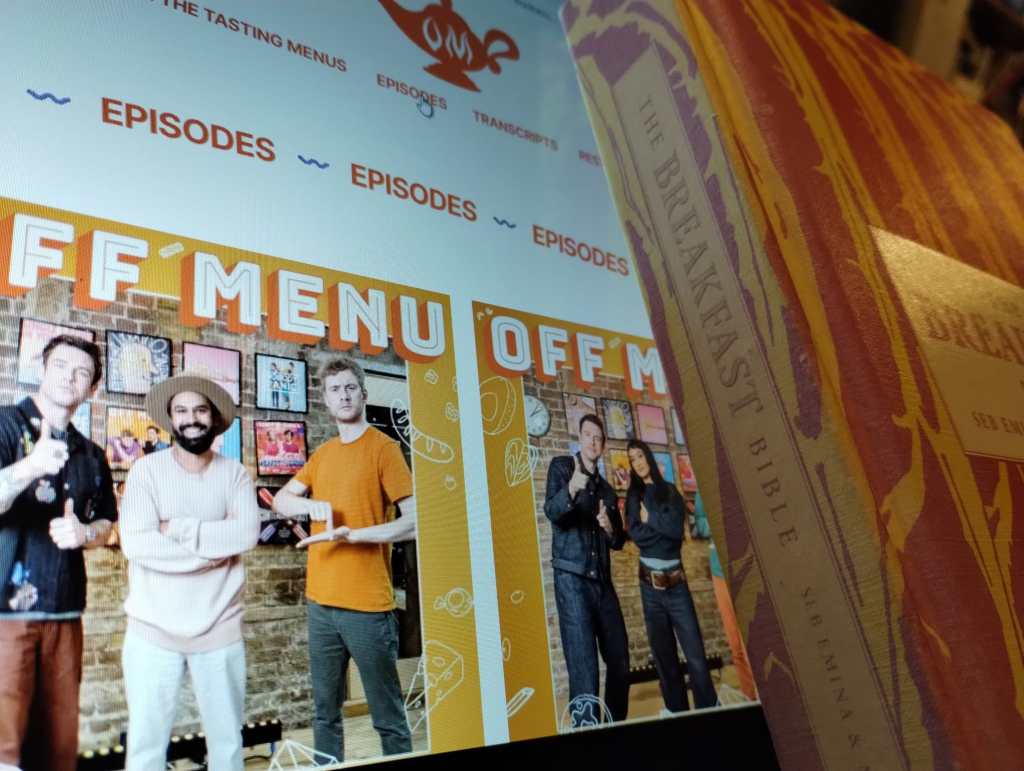
That, in turn, led me to thinking about one of my favourite podcasts, ‘Off-menu’, in which the comedians James Acaster (here a genie waiter) and Ed Gamble interview various celebrities about their dream meal in a dream restaurant. It’s a bit like a food version of desert island discs, and, in the same way that music can be a fascinating jumping off point to gain a glimpse into another person’s life, it turns out that interviewing people about their favourite and formative food experiences often elicits a surprisingly candid window into their past, their likes and dislikes and the pivotal and trivial moments that they’ve experienced.
https://www.offmenupodcast.co.uk/
It has a gentle, Sunday evening telly style vibe and, in my mind, occupies the same kind of space as The Repair Shop, or the Antiques Roadshow. I started listening during the pandemic and found all the foody anecdotes and funny stories a really calming place in those uncertain times. Each guest has to pick their ideal starter, main course, side, dessert and drink (not in that order) and has to avoid a particular ingredient that would have them thrown out of the restaurant (poor Jade).
It turns out that some of the episodes have really lodged in my brain quite vividly. Seeing Joe Wilkinson repeatedly clowning around with Kiera Knightly in one of this year’s inevitable Christmas adverts, I find myself picturing him choking on sliced pickled beetroot and cremating chicken kievs, because he can’t seem to even imagine nice things.
The episode with Romesh Ranganathan seemed to stray eerily close to therapy, starting off with him joking about his dad’s terrible food choices and habits before noticing, about an hour into the episode that he shared his dad’s inclination to deep-fried food (and then realising, with horror that almost every course he’d picked, or considered had also been deep-fried. Even the drink.
Hearing Isy Suttie talk about her partner’s eating habits, and then hearing that partner (Ellis James), in his episode offer his angle on how he eats cereal, or how he’d really just like to have a big plate of sausages, shows a glimpse into their dynamic as a couple. Likewise, hearing Miquita Oliver outline why she leans towards her father’s unfussy Scottish fare, and not the fancy food of her mother, the famous chef Andi Oliver, gives a real sense of their mother/daughter back and forth, and the affection that they have for each other. Andi also is interviewed (separately) in her own episode, and so can fight her own corner, but the discrete episodes build up a slow, but steady picture of how everyone has their own very individual preferences when it comes to food.
It also is a case study into how, sometimes by asking lateral questions in coaching it is possible to start to investigate and gain a map of what’s important to a coachee and how their past informs their preferences and inclinations in the present.
Tom Allen’s episode was a particular delight, in which he talks with genuine affection about how he bunked off school to go on a booze cruise daytrip across the channel with his elderly neighbours.
The format of the podcast provides a framework to allow the hosts and their guests to shoot the breeze about the things that have brought them nostalgia, or bring them comfort. This is much like the OSCAR or GROW models in which the certain framework ensures that there is consistency and rhythm to the discussions. Having some constraints and rules helps the interviewee orientate themselves and enables the hosts to draw out the unknowns all round (ahh, is that Johari’s window again? https://coincidentalcoaching.com/2025/02/10/joe-and-harrys-double-glazing/ )
Our rituals and memories of food (both good and bad) appear to be pretty formative. Thinking back over the foods and meals that we grew up with, the traditions that we’ve internalised and the ones that, as adults, we’ve abandoned with glee and the things that we pass on to our friends, family and kids, food often plays quite a totemic role in our histories.
Over the years of listening to other people’s picks, I’ve been transported back to memories of wonderful Chinese food in Majorca, fresh bread and saucers of coffee in New York, cuttlefish in Cornwall, hot pork rolls in Worcester and my mum’s roast dinners, barbecue ribs and a cornucopia of vegan meals in the 80s, when that was more unusual.
The contrarian in me does think that, when I’m rich and famous and invited to join the high profile names already hosted in the restaurant (Dan Ackroyd, Robert di Nero and Jeff Goldblum all display an eclectic approach to the format, refreshing in their alternative takes), I could see myself picking breakfast as my dream menu.
Breakfast probably is my favourite meal of the day, and a leisurely weekend breakfast with a relaxed several courses, great coffee and fruit juice, maybe bacon sandwiches, sweet pastries, fruit and (apologies for the repetition) great coffee, is a true delight.
It seems I’m not alone in my love of the first meal of the day, Emina and Eggs compiled a really wonderful book on the topic and “The Breakfast Bible” is an engrossing tour of the history and rituals and variants of the humble meal.
So, back to the coincidental coaching in all of this. I think what I’ve learned from listening to dozens and dozens of episodes of Off-menu is that even with something so universal as eating, the variety of experience and the filters that people view the whole issue with unveils an intense microcosm that highlights how eclectic human experience is, and how, unless we ask, we rarely get an insight into how people really experience the day-to-day of existence. In coaching the absolute core of the profession is the curiosity to explore how the world looks from another person’s point of view. It can be very easy to gravitate towards the outliers in our coachee’s experience, but it’s a helpful reminder that a whole universe can be brought to the surface when we talk about the mundane.